
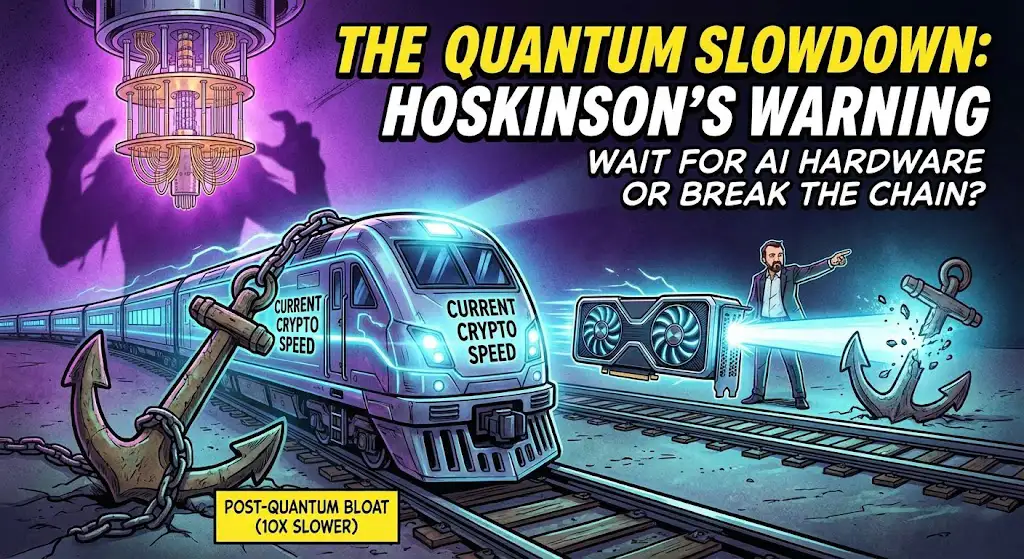
Quick Take Facts:
- Charles Hoskinson warns that rushing into post-quantum cryptography (PQC) could reduce blockchain performance by 10x.
- PQC algorithms currently suffer from significantly larger proof sizes and slower verification times compared to standard Elliptic Curve Cryptography (ECC).
- Hoskinson calls the immediate quantum threat a “red herring,” pointing to 2033 (based on DARPA estimates) as the realistic danger zone.
- He advocates for a “lattice-based” approach that can leverage existing AI hardware (GPUs) rather than waiting for specialized ASICs.
If you are worried about a quantum computer cracking your Bitcoin wallet tomorrow, Charles Hoskinson has a message for you: Calm down. But he also has a warning: The cure we are rushing to invent might be worse than the disease at least for now.
In a recent technical deep-dive that has sparked debate across the industry, the Cardano founder argued that indiscriminately adopting “Post-Quantum Cryptography” (PQC) today would be a catastrophic engineering mistake. According to Hoskinson, the current trade-offs required to future-proof blockchains would result in a 10x degradation in network performance.
The “10x” Problem: It’s All About Weight
Why would upgrading security slow everything down? The answer lies in the mathematics.
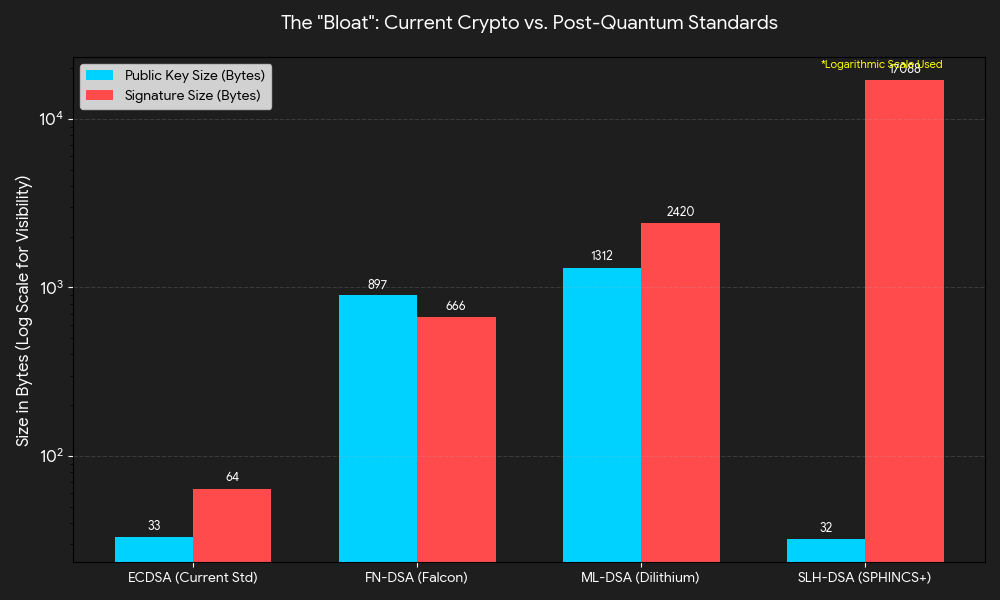
Our current blockchains run on Elliptic Curve Cryptography (ECC). It is lightweight, fast, and generates tiny digital signatures (approx. 64 bytes). This allows networks to process thousands of transactions per second (TPS) without clogging the pipes.
Hoskinson points out that the new PQC standards approved by the National Institute of Standards and Technology (NIST) specifically algorithms like Dilithium or SPHINCS+ are mathematically “heavy.”
“Post-quantum cryptography is often about 10 times slower, has 10 times larger proof sizes, and is 10 times less efficient,” Hoskinson explained.
For a high-performance blockchain, this is a nightmare scenario. Increasing the data size of every transaction by 10x or 40x doesn’t just slow down processing; it explodes the storage requirements for every node in the network.
The “Red Herring” and the 2033 Horizon
So, why is the industry in a panic? Hoskinson believes the current narrative is driven by fear rather than data. He labeled the immediate threat of quantum decryption a “red herring.”
To back this up, he referenced the timeline set by the Defense Advanced Research Projects Agency (DARPA). Their “Quantum Blockchain Initiative” suggests that a cryptographically relevant quantum computer (CRQC) one capable of breaking standard encryption is unlikely to be viable before 2033.
This 8-year buffer provides a crucial strategic window. Hoskinson argues that trying to solve a 2033 problem with 2025 hardware is inefficient. The wiser move is to wait for hardware acceleration to catch up to the math.
The GPU Bet: Riding the AI Wave
The most fascinating part of Hoskinson’s thesis is his proposed solution. Rather than building expensive, custom chips (ASICs) to handle these heavy quantum algorithms, he is betting on the AI revolution.
Hoskinson advocates for Lattice-Based Cryptography. Unlike other methods, lattice mathematics can be highly parallelized meaning it can be broken down into thousands of tiny tasks run simultaneously.
“You can perform all your cryptographic operations on your graphics card, just like AI operations,” he noted.
This is a strategic masterstroke: By aligning crypto’s security upgrades with the hardware architecture of Nvidia and other GPU manufacturers, the blockchain industry can draft behind the trillions of dollars being poured into AI infrastructure. Instead of fighting the bloat, we use the world’s most powerful chips to crush it.