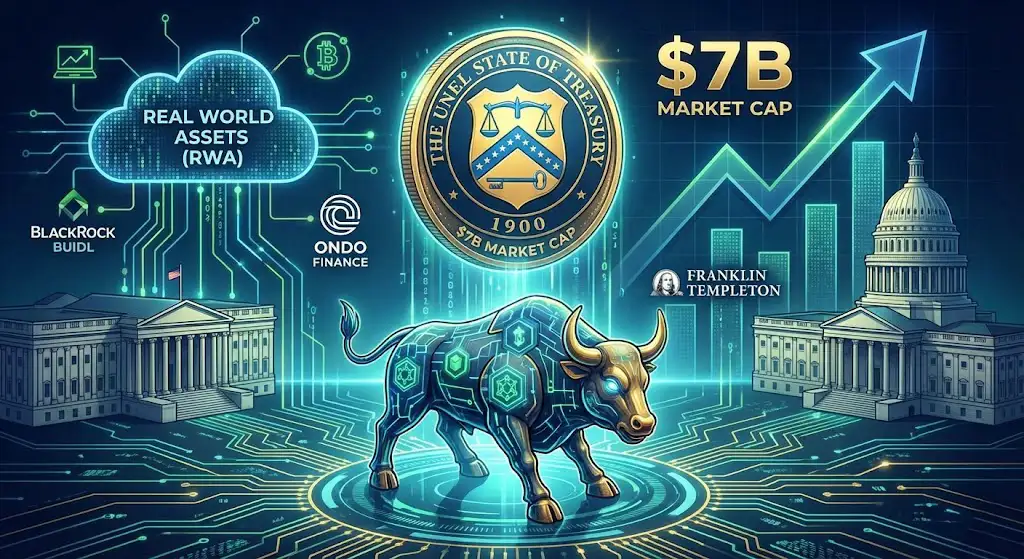
Market capitalization for tokenized U.S. Treasury products surged to nearly $7 billion in December 2025, marking a massive increase from less than $200 million at the start of 2024. This 50-fold growth has been driven primarily by institutional giants seeking safe, on-chain yield and 24/7 settlement capabilities.
Market capitalization for tokenized U.S. Treasury products surged to nearly $7 billion in December 2025, marking a massive increase from less than $200 million at the start of 2024.
This 50-fold growth has been driven primarily by institutional giants seeking safe, on-chain yield and 24/7 settlement capabilities.
Key Market Players & Dominance
- BlackRock (BUIDL): The dominant force in the sector. Its USD Institutional Digital Liquidity Fund (BUIDL) has amassed nearly $2 billion in assets under management (AUM). It serves as a “credibility anchor,” encouraging other institutions to enter the space.
- Franklin Templeton (FOBXX): An early mover with its OnChain U.S. Government Money Fund, which utilizes the Stellar and Polygon networks.
- Ondo Finance: A significant player bridging DeFi and institutional finance with products like OUSG (Short-Term U.S. Government Bond Fund) and USDY.
- Other Notable Issuers: Superstate, Securitize (BlackRock’s partner), and Circle have also launched competitive yield-bearing treasury products
For the last decade, if you kept your money in stablecoins (USDT/USDC), you were essentially giving Tether and Circle an interest-free loan. They took your dollars, bought T-Bills, earned the 4-5% yield, and kept the profit.
The $7B pivot means the market is waking up. Institutions and high-net-worth individuals are saying, “Why should Tether keep that yield? I want it.”
This growth tells me two things about the current market state in late 2025:
- DeFi is Growing Up: We are moving from “speculative yield” (printing tokens out of thin air) to “real yield” (passing through government interest).
- Collateral Utility: This is the game-changer. Earlier this year, we saw platforms like Deribit and Crypto.com start accepting tokenized treasuries as collateral. Traders can now earn ~3.6% on their idle margin while they trade. That is capital efficiency at its finest.
This growth tells me two things about the current market state in late 2025:
- DeFi is Growing Up: We are moving from “speculative yield” (printing tokens out of thin air) to “real yield” (passing through government interest).
- Collateral Utility: This is the game-changer. Earlier this year, we saw platforms like Deribit and Crypto.com start accepting tokenized treasuries as collateral. Traders can now earn ~3.6% on their idle margin while they trade. That is capital efficiency at its finest.
| Product | Issuer | Approx. AUM | Yield (APY) | The Verdict |
| BUIDL | BlackRock / Securitize | ~$3.0B | ~3.56% | The institutional standard. If you are a whale, you park here. |
| OUSG / USDY | Ondo Finance | ~$1.5B | ~3.68% | The “DeFi Native” choice. Better integration with other protocols. |
| FOBXX (Benji) | Franklin Templeton | ~$850M | ~3.60% | The early mover, but currently lagging behind BlackRock’s momentum. |
The Titan vs. The King: BlackRock’s BUIDL vs. Tether (USDT)
The truth is that “safety” means different things to different people in the crypto world.
Tether (USDT) has been the clear leader in liquidity for years. It’s the “digital dollar” that lets you do everything from trade Bitcoin to buy coffee in Lugano. But now that BlackRock’s BUIDL is in the game, things have changed.
We’re not just comparing two tokens anymore; we’re comparing two very different ways of thinking about money. One is a regulated fortress that pays you, and the other is an unregulated cowboy who keeps the money.
This is the in-depth risk assessment you need to do before moving your money.
1. The “Yield” Trap: Who Gets Paid?
This is the single biggest difference.
- USDT: Tether holds U.S. Treasurys, earns ~4-5% interest, and keeps 100% of it. You hold the risk; they take the profit. It’s a great business model for them, terrible for you.
- BUIDL: BlackRock passes the yield (minus fees) directly to you. The token price stays at $1.00, but your balance increases daily (rebasing).
- Analyst Verdict: If you are holding idle capital for more than a week, holding USDT is literally burning money.
2. The Liquidity & Access Barrier (The Real Risk)
Here is where BUIDL fails for the average retail trader.
- USDT: It is the most liquid asset in crypto history. You can sell $10 million of USDT on Binance in seconds. You can send it to a friend in Brazil without asking permission.
- BUIDL: It is a “Permissioned” token. You cannot just send it to anyone. The recipient wallet usually needs to be whitelisted (KYC’d). If you need to exit a position instantly during a market crash, BUIDL is slower and clunkier.
- Analyst Verdict: USDT wins on speed and freedom. BUIDL is an institutional product; it’s not designed for day trading.
3. The “Censorship” Switch
Don’t be fooled both are centralized. But the motivation to freeze your funds differs.
- BlackRock (BUIDL): They are a U.S. entity. If the SEC, FBI, or OFAC sends them a letter, they will freeze your assets immediately. There is no debate. It is total compliance.
- Tether (USDT): While Tether can and does freeze addresses (mostly related to hacks), they are historically more resistant to sweeping U.S. regulatory overreach because they operate offshore.
- Analyst Verdict: If you are worried about government seizure, neither is safe. But BlackRock is essentially a government branch in this context.
What Should You Do?
The answer depends on who you are.
- For the Day Trader: Stick with USDT. You need the speed. You need to be able to jump into a trade on Bybit or Binance at 3:00 AM without worrying if your counterparty is “whitelisted.” The opportunity cost of missing a trade is higher than the 4% yield you lose.
- For the “HODLer” / Treasury Manager: Move to BUIDL (or its retail wrappers like Ondo’s OUSG). Leaving $100k+ sitting in USDT for a year is financial negligence. You are leaving ~$4,000 on the table for no reason.
The “Hybrid” Strategy: Smart money is doing this: Keep 20% of your stablecoins in USDT for immediate “dry powder” to buy dips. Put the other 80% (the boring money) into tokenized treasurys to compound wealth while you wait.
Disclaimer: This is not financial advice. BlackRock’s BUIDL is generally available only to qualified purchasers. Retail users often access these yields through secondary wrappers like Ondo Finance, which carry their own smart contract risks.